
Rebuilding worn, broken-down and failing dentitions is the heart of prosthodontics — and the work Dr. Succaria is best known for: one diagnosis, one design, one staged plan.
If any of this is familiar: these are not hopeless cases. They are exactly the cases prosthodontists train for.
When many teeth are involved, nothing can be decided tooth by tooth. The bite, the esthetics, the materials, the gum health, and the order of treatment all depend on each other — change one and you change them all. That is why patchwork fails: it treats each tooth as a separate problem.
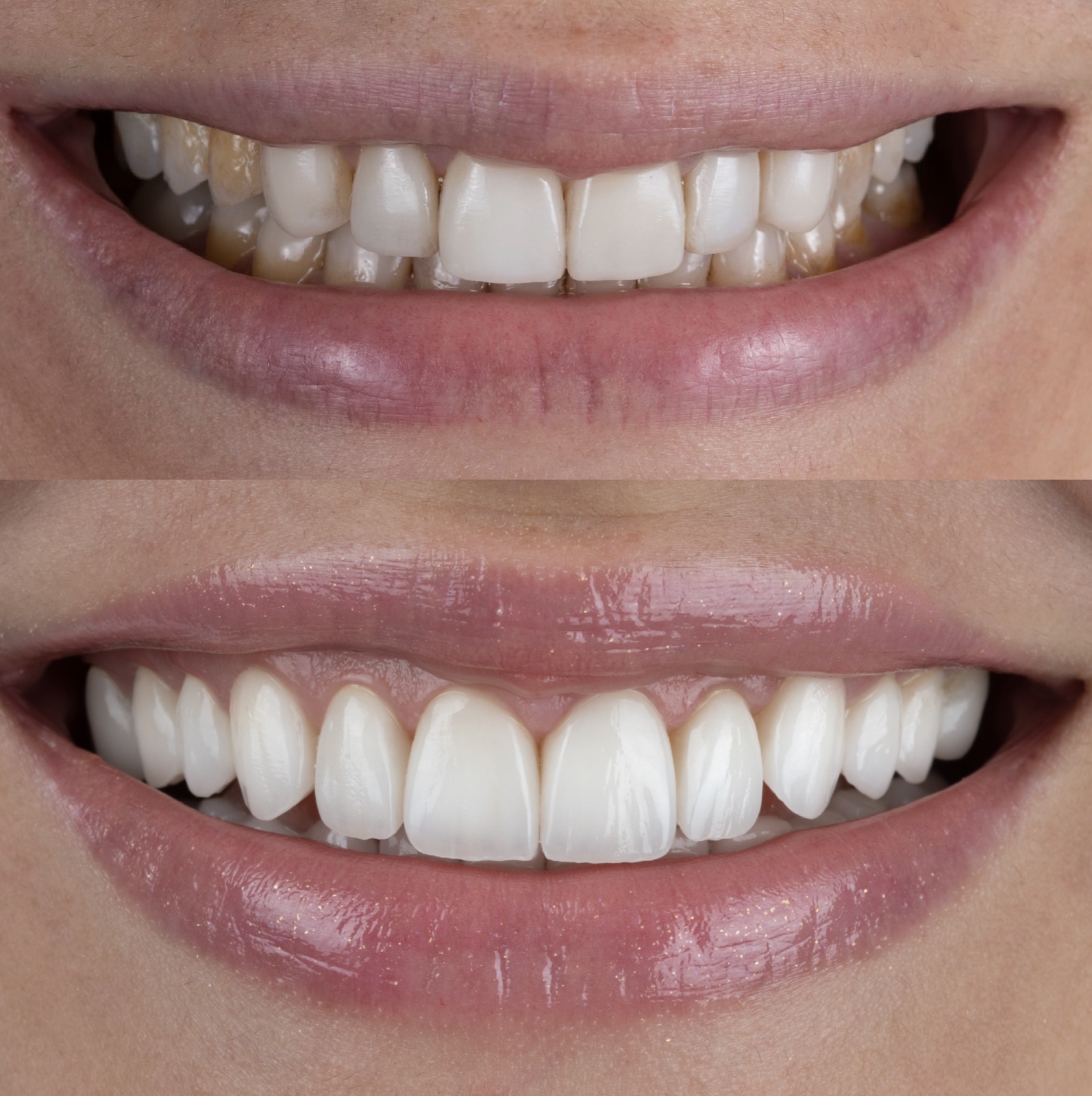
Full-mouth rehabilitation reverses the logic. The final result — how your teeth will look, meet, and function — is designed first. Then every step is sequenced to reach it. This is the core of specialty prosthodontic training, and the work Dr. Succaria has built his reputation on: complex rehabilitations with veneers and crowns, more than 15,000 ceramic restorations delivered.
Full examination, photographs, scans, bite analysis — and an honest conversation about what you want and what your mouth needs.
Your future smile and bite are designed as one: tooth proportions, bite position, and materials — planned digitally before anything is touched.
You see and discuss the plan. In many cases the new smile is test-driven with provisional restorations — you live with the new bite before it becomes final.
Executed in phases: foundations first (gum health, bite stability), then reconstruction — arch by arch or section by section, at a pace that fits your life.
Final ceramics are placed and the bite fine-tuned — and your investment is protected, including a night guard where grinding is part of the story.
Timeline honesty: comprehensive rehabilitation is measured in weeks to months, not days — and it can often be staged over a longer period when that suits you better. You'll know the phases, the timing, and the fees before treatment begins.
Worn and broken-down dentitions are almost never just an esthetic problem — they are a functional one. Rebuilding without understanding why the damage happened guarantees it will happen again, this time to expensive ceramics.
Bite analysis is built into every rehabilitation plan: how your jaw moves, where the forces go, and how the new teeth must be shaped to survive them. More on bruxism, bite & TMD →
A rehabilitated mouth should not announce itself. The same design principles that make a single veneer undetectable — individual tooth shapes, natural color gradients, proportion matched to your face — apply across a full arch. The goal is a mouth that works in comfort and looks like it was always meant to be yours.
In most cases, yes. Worn dentitions are rebuilt by restoring the lost height and protecting the new teeth from the cause of the wear. It requires comprehensive planning — which is precisely what a prosthodontist is trained for.
With a diagnosis, not a decision. A comprehensive assessment maps the condition of every tooth, the bite, and the gums — then organizes everything into one prioritized, staged plan. You'll finally see the whole picture instead of one emergency at a time.
Typically weeks to months depending on complexity — and it can often be phased over a longer period. You'll know the stages and timing before starting.
Usually, yes. A well-designed plan can be executed in phases without compromising the final result — foundations first, reconstruction after.
That is the point of specialist design: individual tooth forms, natural color and translucency, and proportions that suit your face — at any scale.
It depends entirely on the diagnosis — the number of teeth, the materials, and the phases involved. After your assessment you receive a written plan with exact fees per phase, and alternatives where they exist.
Dr. Succaria teaches complete mouth reconstruction to dentists in hands-on workshops. For dentists →
One comprehensive assessment replaces years of one-tooth-at-a-time uncertainty. Bring your history — leave with a map.